
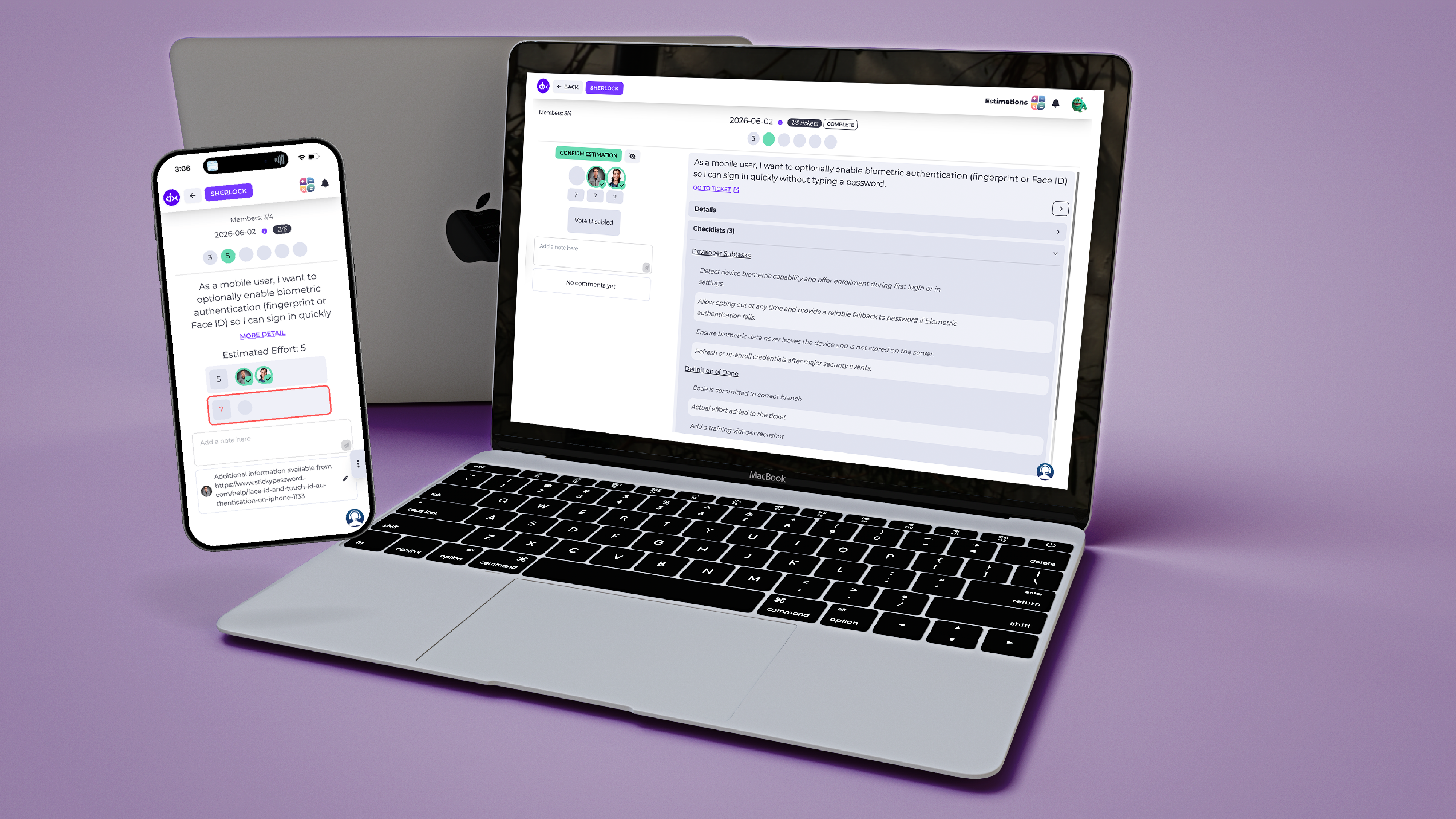
In a previous post, we explored how the Requirements app allows you to shape abstract ideas into highly organised, traceable specifications. But before a developer starts building those features, there is a critical middle step that bridges the gap between product management and engineering: Estimations.
Accurate forecasting is the secret to a healthy development cycle. The Divblox Estimations App is engineered to transform estimating from a tedious administrative chore into a strategic, collaborative superpower for your team.
Collaboration at the Core
Estimating a ticket shouldn’t happen in a vacuum. The Estimations app is explicitly designed to host collaborative estimating sessions, especially if you use Planning Poker. It provides a shared environment where stakeholders, product owners, and developers can gather to discuss a ticket’s complexity, align on scope, and eliminate assumptions before development commences. To keep things standardised, the app’s default complexity points are based on the Fibonacci sequence (0.5, 1, 2, 3, 5, 8, 13). This helps teams abstract time and focus purely on relative effort and complexity, leading to much more accurate long-term forecasting.
Advanced Features for Smarter Team Alignment
The Estimations app doesn’t just let people throw numbers at a screen; it provides the granular tools needed to understand the sentiment behind the numbers:
- Ticket-Level Confidence Levels: Beyond a raw number, developers can vote on their confidence level for a specific ticket. If the team votes a “5” but confidence is low, it tells the product owner that the requirement might still be too ambiguous and needs further refinement.
- Persistent Estimation Comments: The discussions that happen during estimation sessions are goldmines of context. In Divblox, comments added during the session can be attached directly to the ticket. They remain fully available to the developer during active development, ensuring that critical technical decisions or edge cases discussed during the session are never lost.
- Re-Estimate & Override: Scope changes, and so should your numbers. The app allows teams to easily trigger a re-estimate if a ticket’s parameters shift. Furthermore, team leads or product owners have the capability to override a vote when final business or technical constraints demand a specific adjustment.
- View-Only Mode: Want to onboard a new developer or let a client stakeholder observe how your engineering team operates? The view-only option allows users to sit in on the session, track the voting, and learn the team’s velocity dynamics without interfering with the active estimation pool.
- Anonymous Voting: To prevent “anchoring bias”, where junior developers simply match the score of a senior architect, the Estimations app utilises anonymous voting. Team members cast their complexity estimates in secret. Once everyone has voted, the scores are revealed simultaneously, fostering genuine independent thinking and honest technical assessments.

The Gateway to Predictable Sprint Planning
Why do we spend this time estimating? Because estimated work is the foundational ingredient for predictable sprint planning.
By knowing the relative complexity of your backlog, product owners can build sprints that perfectly match the team’s historical capacity. The result is repeatable, predictable delivery cycles where deadlines are hit with confidence rather than guesswork.